Weather Systems Reshape Fractional Odds in Regional Horse Racing Circuits
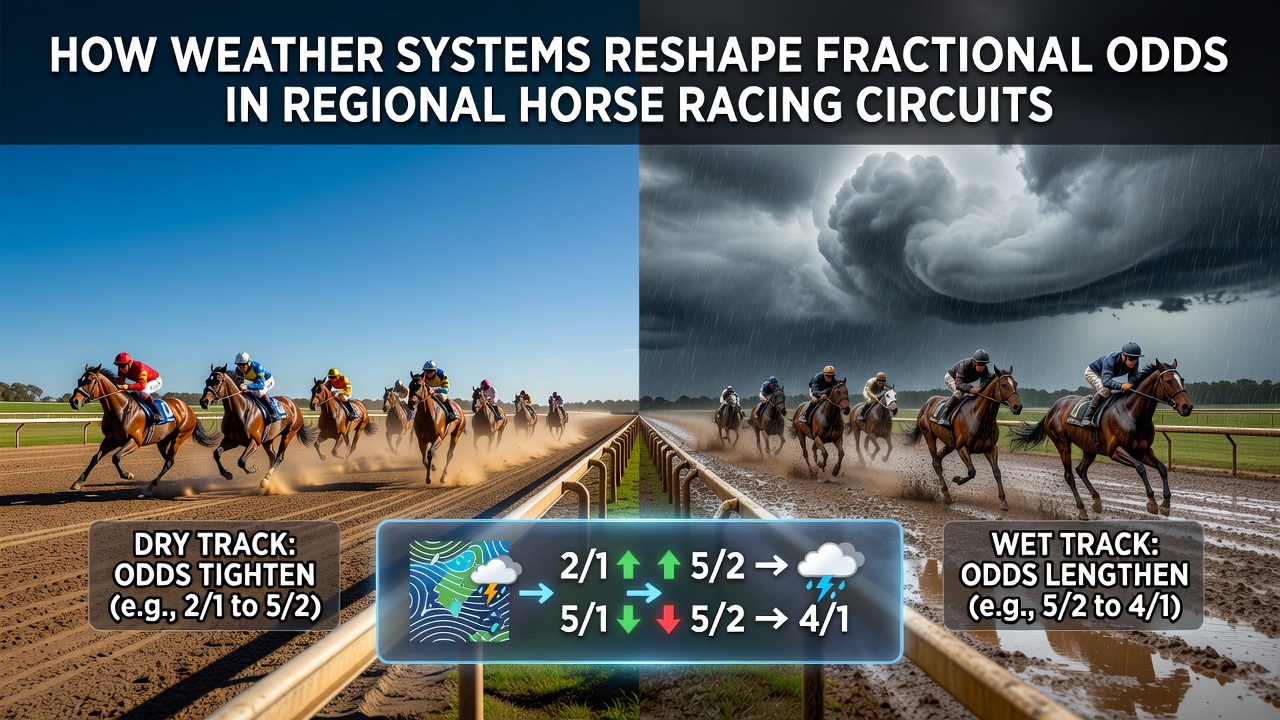
Weather systems move across racing regions and alter track surfaces in ways that shift horse performance profiles, which in turn adjust the fractional odds offered by bookmakers and betting exchanges in circuits from the American Midwest to Australian state tracks. Fractional odds, expressed as ratios such as 5/2 or 7/4, reflect implied probabilities that markets recalculate when ground conditions change from firm to soft or from fast to heavy.
Track Surface Responses to Precipitation and Temperature
Heavy rainfall saturates turf and dirt surfaces, increasing moisture content and slowing times for horses that prefer firmer footing while improving prospects for those suited to yielding or heavy ground. Temperature swings compound these effects because frozen or thawing tracks create inconsistent footing that regional handicappers must factor into morning line calculations. Data from circuits in Victoria and New South Wales show that races run after 25 millimetres of rain in a 24-hour period produce measurable shifts in finishing order distributions, prompting oddsmakers to lengthen prices on speed-oriented runners and shorten those on closers with proven wet-track form.
Regional Circuit Characteristics and Weather Sensitivity
Tracks in the American Midwest operate on dirt surfaces that respond quickly to thunderstorms, whereas coastal Australian venues often contend with persistent drizzle that turns grass into a holding surface. Observers note that these differences create distinct betting patterns: Midwestern circuits see larger odds movements on favourites when rain arrives within 48 hours of post time, while state circuits in Queensland adjust fractions more gradually because drainage systems mitigate some surface changes. Research from the University of Melbourne equine studies group indicates that regional horses develop track-specific adaptations, so a sudden weather shift can nullify prior form lines and force markets to reprice entire fields.
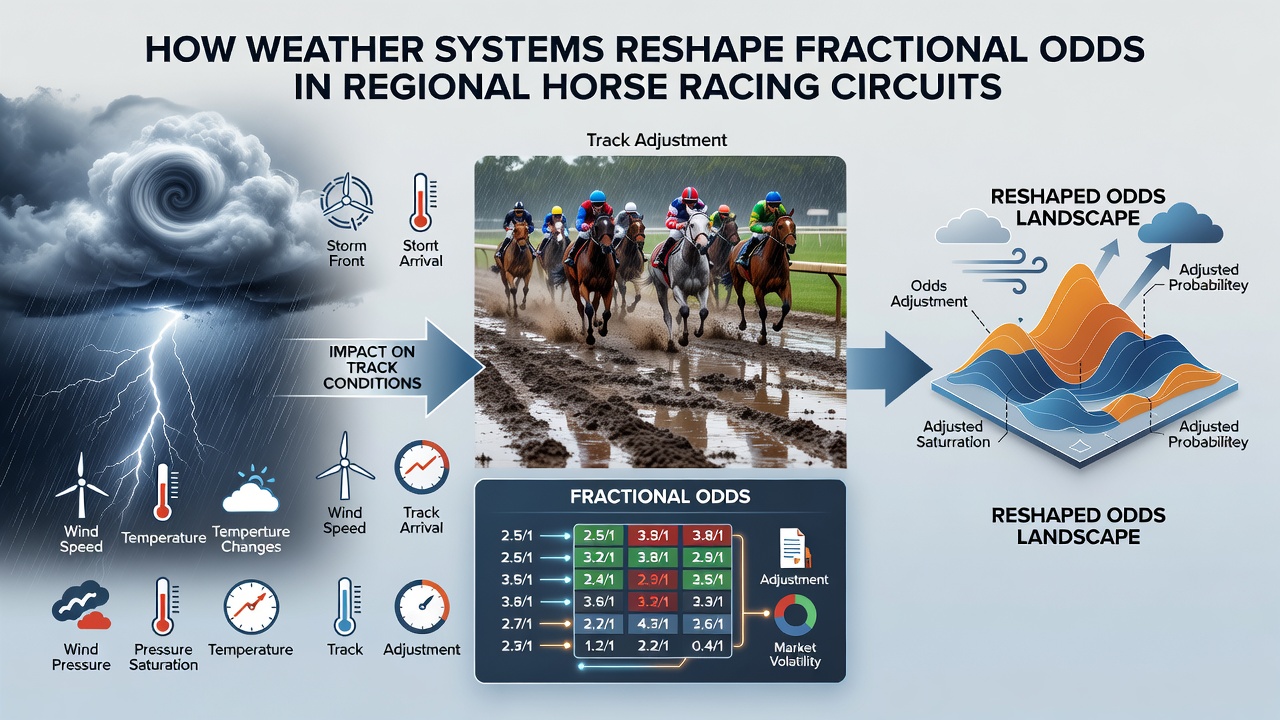
August 2026 brought repeated frontal systems through several circuits, producing extended periods of soft ground that coincided with measurable contraction in certain fractional odds. Fields that had opened at 4/1 on speed horses shortened to 5/2 for proven mud runners within hours of rain forecasts, illustrating how quickly layers and exchanges incorporate meteorological data into pricing models.
Odds Adjustment Mechanisms in Fractional Markets
Bookmakers maintain liability management systems that monitor weather forecasts alongside historical performance databases, allowing them to move fractions in real time as track reports update. When a circuit posts an official going report of “good to soft,” layers widen the spread between horses with contrasting ground preferences, often converting decimal probabilities into fractional equivalents that reflect the new risk profile. Exchanges, by contrast, let market participants drive the fractions through matched bets, and volume spikes frequently occur when radar shows incoming precipitation that was not anticipated in opening prices.
Industry reports compiled by the Association of Racing Commissioners International document that weather-related odds revisions account for a measurable share of total market movement in regional meets, particularly in circuits without sophisticated irrigation that can counteract natural rainfall. Those adjustments appear in both pre-race and in-running markets, where live fractional odds react to on-course observations of how individual runners handle the altered surface.
Case Examples from Multiple Regions
One documented meet in a Canadian prairie circuit saw a late-August thunderstorm convert a fast track to sloppy conditions overnight, prompting fractional odds on the morning favourite to drift from 6/4 to 3/1 while a proven off-track specialist shortened from 8/1 to 9/4. Similar patterns emerged in a South Australian provincial circuit when unseasonal heat followed by sudden downpours created a sticky surface that favoured horses with proven stamina, altering the fractions offered on several mid-priced runners. These examples demonstrate how weather data integrates into the probability models that underpin fractional pricing across geographically separated circuits.
Conclusion
Weather systems continue to influence fractional odds in regional horse racing circuits by modifying track conditions that directly affect horse performance hierarchies. Markets incorporate meteorological updates through a combination of automated models and human layers who adjust fractions according to revised probabilities. Regional differences in surface type and drainage infrastructure produce varied responses, yet the core mechanism remains consistent: changed ground conditions prompt repricing that reflects new performance expectations. Observers tracking August 2026 data across multiple circuits confirm that these weather-driven adjustments remain a recurring feature of fractional betting markets in local racing environments.