Probability Shifts and Their Cascade Through Mixed-Sport Accumulators
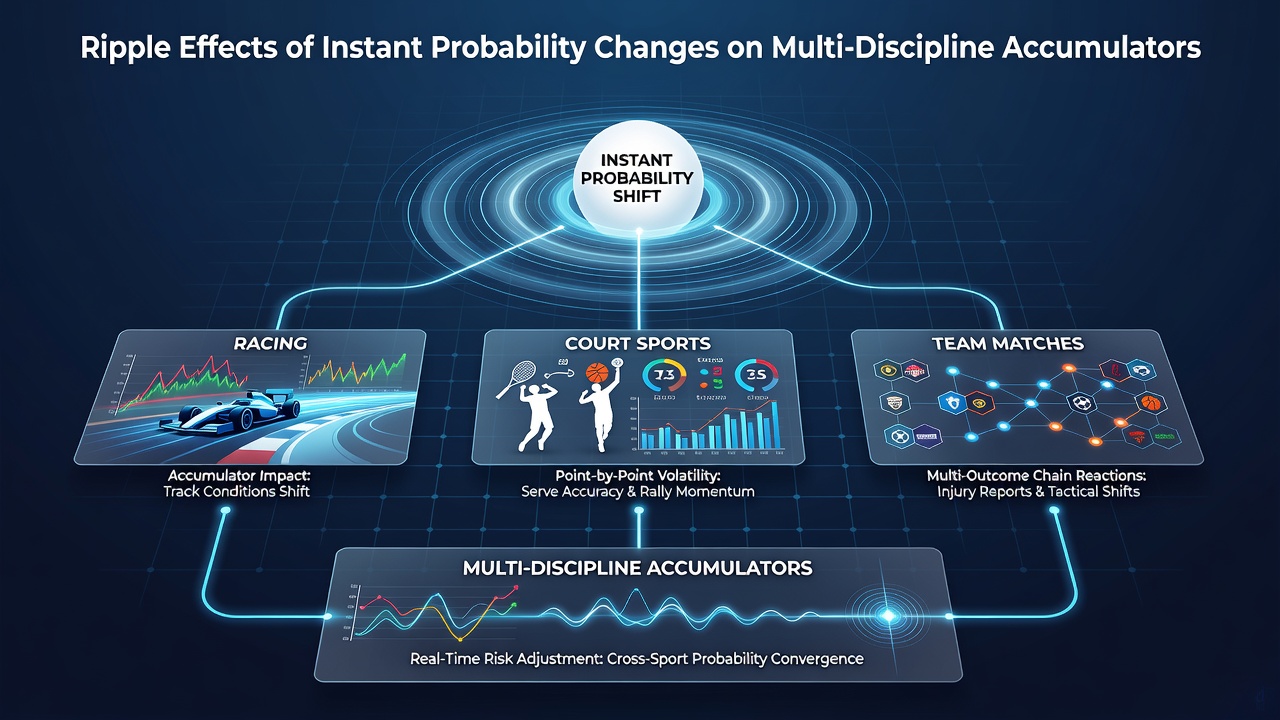
Instant probability changes ripple through multi-discipline accumulators that combine elements from horse racing, court sports such as tennis, and team matches including football, creating interconnected adjustments that bettors monitor in real time. These accumulators link selections from disparate disciplines where a sudden shift in one market can recalibrate the overall payout multiplier because each leg contributes to the compounded odds. Data from industry tracking services indicates that live betting volumes on such combinations rose noticeably during major summer fixtures in July 2026, when overlapping schedules of racing meets, tennis tournaments, and league matches coincided.
Mechanics of Live Probability Adjustments
Bookmakers recalculate odds continuously based on incoming data streams that include player performance metrics, track conditions, and match events, so a single goal in a team match or a break of serve in tennis can trigger immediate revisions that propagate to linked accumulator lines. Observers note that racing markets respond particularly fast to changes in going or late jockey announcements, whereas court sports react to momentum swings visible through point-by-point scoring. When these updates occur simultaneously across disciplines, the accumulator total adjusts through algorithmic models that factor in correlation coefficients between the events, and those coefficients often strengthen during overlapping broadcast windows because viewer attention influences liquidity in each market.
Impact on Racing Components Within Accumulators
Horse racing legs within multi-discipline bets experience probability flux from factors such as non-runners, draw biases, and pace maps that evolve right up to post time, so an accumulator containing a morning-line favorite can see its contribution shrink rapidly if late information emerges about ground conditions. Researchers tracking betting patterns have found that such revisions frequently align with parallel movements in tennis or football selections when events share the same afternoon or evening slots, because operators apply unified risk-management frameworks across their platforms. In July 2026, several high-profile racing cards overlapped with Grand Slam qualifying rounds and pre-season football friendlies, producing documented instances where a single late scratching altered the projected returns on thousands of mixed accumulators.
Court Sports and Rapid Momentum Shifts
Tennis accumulators react to probability changes measured in real time through serve percentages, break-point conversion rates, and fatigue indicators that update after every point, allowing odds to swing dramatically within a single game. When bettors combine these court-sport selections with racing or team-match outcomes, the accumulator becomes sensitive to asynchronous events because a tennis match can conclude while a horse race is still running or a football half-time interval is underway. Figures from market analysis firms reveal that live odds in tennis often exhibit higher volatility than pre-match lines, and this volatility transmits directly into the multiplier applied to the full accumulator once the remaining legs settle.

Team Match Dynamics and Cross-Market Correlations
Football and other team-match selections introduce probability changes driven by goals, red cards, and substitution patterns that alter expected goal totals within minutes, and these movements interact with racing and tennis legs through shared liquidity pools maintained by operators. Studies compiled by the American Gaming Association highlight how in-play data feeds synchronize across sportsbooks, enabling rapid repricing that affects accumulators spanning three or more disciplines. When a team match enters extra time or a penalty shootout while a race meeting continues, the combined probability surface for the accumulator can shift by double-digit percentages in under a minute, according to aggregated transaction logs released by several international operators.
Observed Ripple Patterns in July 2026
During July 2026, overlapping calendars produced measurable examples of cascade effects where an early tennis retirement coincided with a racing non-runner and a football red card, resulting in coordinated adjustments that reduced accumulator payouts across multiple platforms. Industry reports from the Australian Gambling Research Centre documented similar patterns in prior years, noting that bettors who monitored multiple live feeds simultaneously captured value before the full ripple stabilized. Those patterns arise because operators apply hedging algorithms that treat the accumulator as a single portfolio rather than independent legs, so an adverse movement in one sport prompts defensive repricing in others to maintain margin targets.
Conclusion
Instant probability changes therefore function as interconnected signals that travel through multi-discipline accumulators involving racing, court sports, and team matches, with each discipline contributing distinct volatility profiles that operators and data providers track continuously. The structure of these bets means that a revision originating in one market can alter expected returns on the entire combination even when the remaining events have not yet begun, and this dynamic intensifies during periods of dense fixture overlap such as the summer months of 2026. Market participants who follow these movements rely on synchronized data feeds and correlation models to anticipate the scale of adjustments, while regulatory bodies in multiple jurisdictions continue to examine the transparency of live-odds dissemination across such products.